
Duas for Umrah: What to Say at Each Step
Umrah is a journey of supplication as much as ritual. While most steps have no single obligatory dua, reciting authentic supplications, and pouring out your own from the heart, is what fills the journey with meaning. This guide gathers the recommended duas for each step of Umrah, with transliteration and English meaning, so you can prepare before you travel. Follow it alongside our pillar guide on how to perform Umrah.
A note on making dua
There is no fixed script you must recite word-for-word at every moment of Umrah. The supplications below are recommended (Sunnah or widely practised), but your own sincere dua, in any language, is beloved to Allah. Makkah and the Haram are among the most blessed places to ask, so prepare a personal list of what you most want to pray for.
1. The Talbiyah (on entering Ihram)
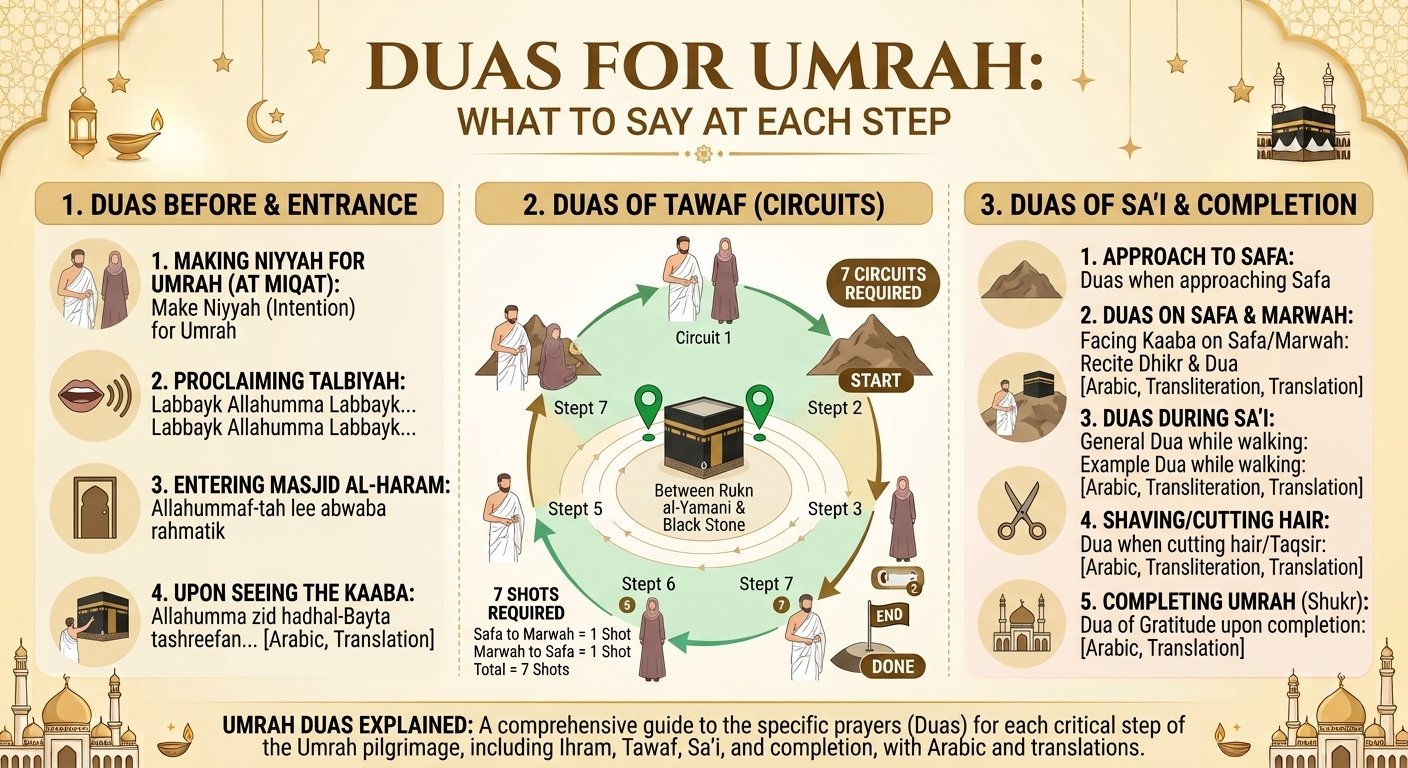
Begin the Talbiyah at the Miqat and repeat it often until you start Tawaf: “Labbayk Allahumma labbayk, labbayka la sharika laka labbayk, innal-hamda wan-ni’mata laka wal-mulk, la sharika lak,” meaning “Here I am, O Allah, here I am. You have no partner, here I am. All praise, grace and dominion belong to You. You have no partner.” Learn more in how to enter Ihram.
2. Entering Masjid al-Haram
Enter with your right foot and say the dua for entering any mosque: “Allahummaftah li abwaba rahmatik” (“O Allah, open for me the doors of Your mercy”).
3. On first seeing the Kaaba
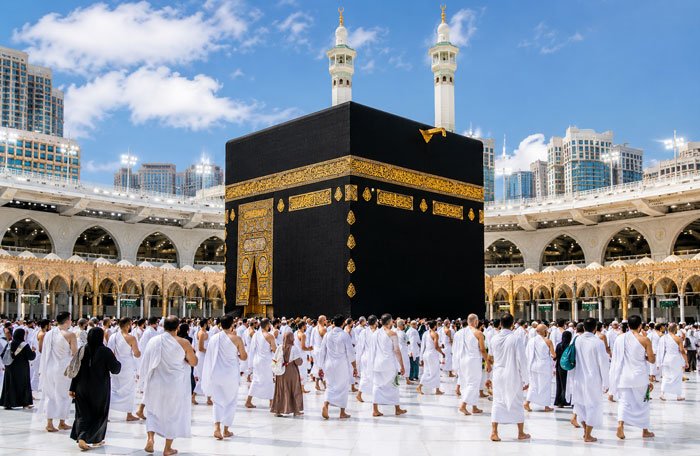
When your eyes fall on the Kaaba, this is a moment when dua is answered. Raise your hands and make sincere personal supplication for yourself, your family and the Ummah. There is no fixed wording required, so ask freely.
4. During Tawaf
There is no obligatory dua for each circuit; recite Quran, dhikr and personal dua throughout. Between the Yemeni Corner and the Black Stone, recite the well-known verse: “Rabbana atina fid-dunya hasanah, wa fil-akhirati hasanah, wa qina adhaban-nar” (“Our Lord, give us good in this world and good in the Hereafter, and protect us from the punishment of the Fire”). See the full method in how to perform Tawaf correctly.
5. At Maqam Ibrahim and Multazam
Before praying the two rak’ah after Tawaf, it is Sunnah to recite: “Wattakhidhu min maqami Ibrahima musalla” (“And take the station of Ibrahim as a place of prayer”). At the Multazam, between the Black Stone and the Kaaba’s door, make earnest personal dua if you can reach it.
6. Drinking Zamzam
When drinking Zamzam, face the Kaaba, say Bismillah, and make dua, it is narrated that Zamzam is for whatever purpose it is drunk. Ask for health, guidance and whatever good you seek.
7. During Sa’i
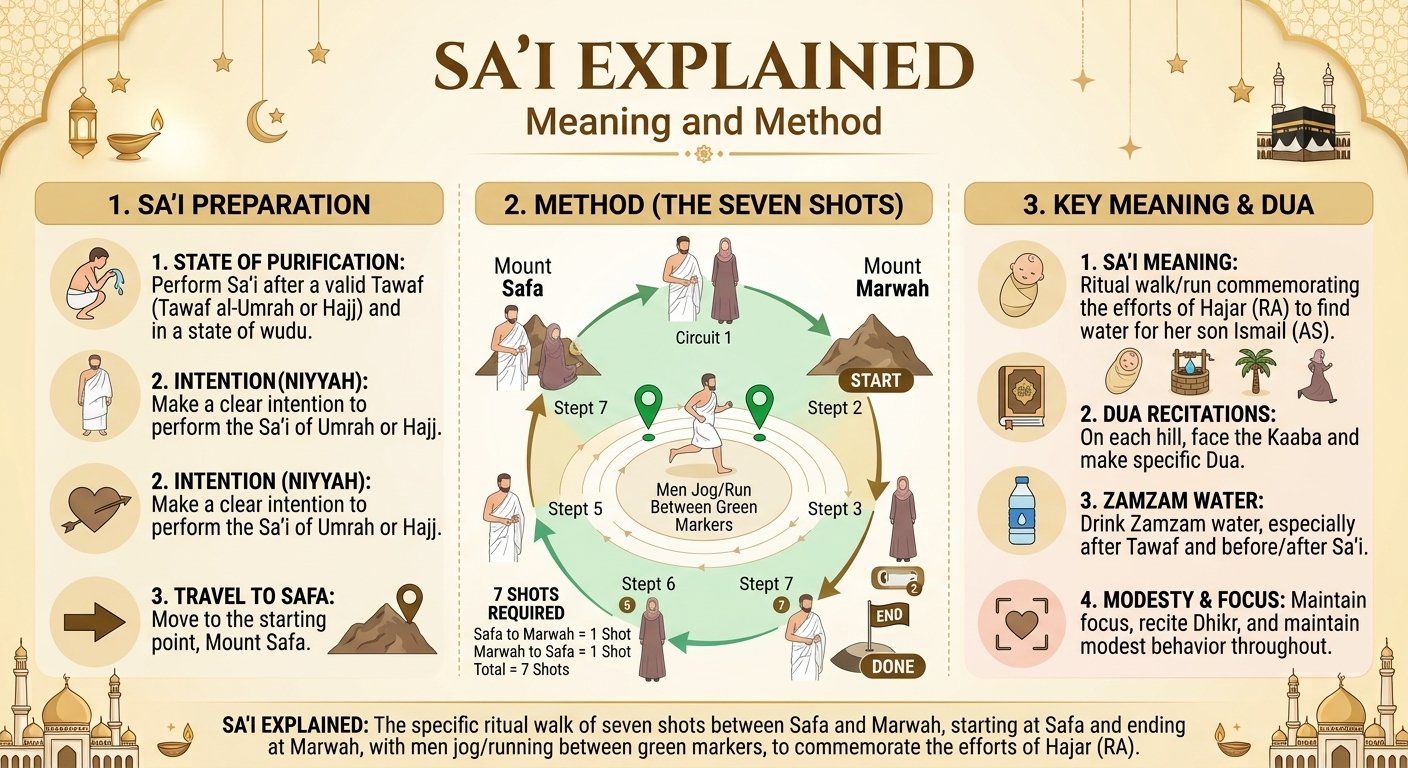
As you approach Safa, recite: “Innas-safa wal-marwata min sha’a’irillah” (“Indeed, Safa and Marwah are among the symbols of Allah”), then “Abda’u bima bada’allahu bihi.” On Safa and Marwah, face the Kaaba, praise Allah, say the takbir and make dua. Between circuits, supplicate freely. See the full ritual in Sa’i between Safa and Marwah.
8. After completing Umrah
After Halq or Taqsir, thank Allah for enabling you to complete your Umrah, and ask that it be accepted. Continue to make dua throughout your stay, especially in the final moments before leaving the Haram.
Tips for making the most of your duas
- Prepare a written list of personal duas before you travel, you will not want to forget anyone.
- Learn the meanings, not just the sounds, so your heart is present.
- Make dua for others; the angels say “and for you the same.”
- Keep a small dua booklet or app, but do not let reading distract from sincerity.
Frequently asked questions
What dua do you say during Tawaf?
There is no fixed dua for each circuit. Between the Yemeni Corner and the Black Stone, recite “Rabbana atina fid-dunya hasanah…” and otherwise make free supplication.
Is there a fixed dua for Sa’i?
No single obligatory dua. It is Sunnah to recite the verse of Safa and Marwah on approaching Safa, then supplicate freely.
What is the Talbiyah?
The pilgrim’s call recited from the Miqat: “Labbayk Allahumma labbayk…”, repeated often until Tawaf begins.
Can I make dua in my own language?
Yes. Personal dua in any language is beloved to Allah, alongside the recommended supplications.