
Ihram is the doorway to Umrah. Get it right and everything that follows feels calm and correct; get it wrong and you may owe an expiation or, at worst, invalidate your intention. Yet entering Ihram is simple once you break it into its parts. This guide explains how to enter Ihram step by step, where the Miqat boundaries are, what is forbidden while in Ihram, and the mistakes first-time pilgrims most often make.
What is Ihram?
Ihram is a sacred state of purity and intention that a pilgrim enters before performing Umrah or Hajj. It is not only the two white cloths a man wears, those are a symbol. Ihram is really the combination of your niyyah (intention), the Talbiyah you recite, and the restrictions you accept from that moment until you complete your rites. Understanding this distinction is the first step to entering it correctly, and it sits at the heart of how to perform Umrah.
Step 1: Prepare your body before Ihram
Before you put on Ihram, take care of personal grooming, because you cannot do these things once you are in the sacred state:
- Trim your nails and remove unwanted body hair.
- Make ghusl (a full ritual bath) if possible; otherwise perform wudu.
- Men may apply perfume to the body (not to the Ihram cloth) before entering Ihram, but not after.
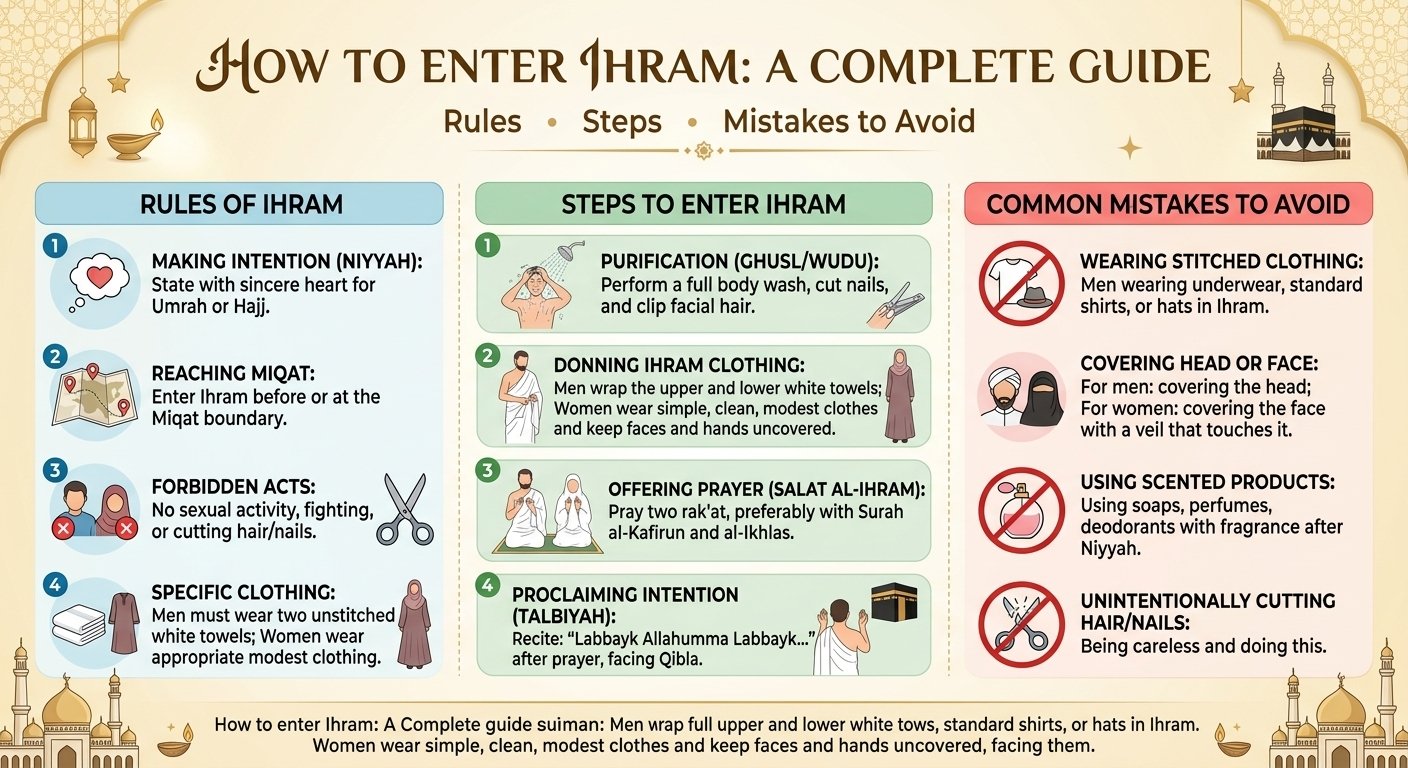
- Men wear two clean, unstitched white sheets: the izar (lower) and rida (upper). Women wear ordinary modest clothing; there is no fixed colour or style for them beyond proper covering.
Step 2: Enter Ihram at the Miqat
The Miqat is the boundary at which entering Ihram becomes obligatory. You must be in Ihram before you cross it, not after. There are five appointed Miqat points depending on the direction you arrive from:
- Dhul-Hulayfah (Abyar Ali), for those coming from or via Madinah.
- Al-Juhfah (near Rabigh), for those from the direction of Syria, Egypt and the West.
- Qarn al-Manazil (As-Sayl al-Kabir), for those from the direction of Najd.
- Yalamlam, for those from the direction of Yemen.
- Dhat Irq, for those from the direction of Iraq.
If you are flying, your Miqat is the point your route passes over, so enter Ihram on the plane before it, or at the airport, as your group leader advises. Pilgrims already inside Makkah who wish to perform Umrah leave the Haram boundary to a place such as Masjid Aisha (Tan’im) to enter Ihram. Confirm your exact Miqat with your travel guide based on your itinerary.
Step 3: Make your intention (niyyah)
At the Miqat, form the intention for Umrah in your heart. The intention is what turns your travel into worship. Keep it sincere and focused on Allah alone; there is no need to say a long formula aloud, the heart’s intention is what counts.
Step 4: Recite the Talbiyah
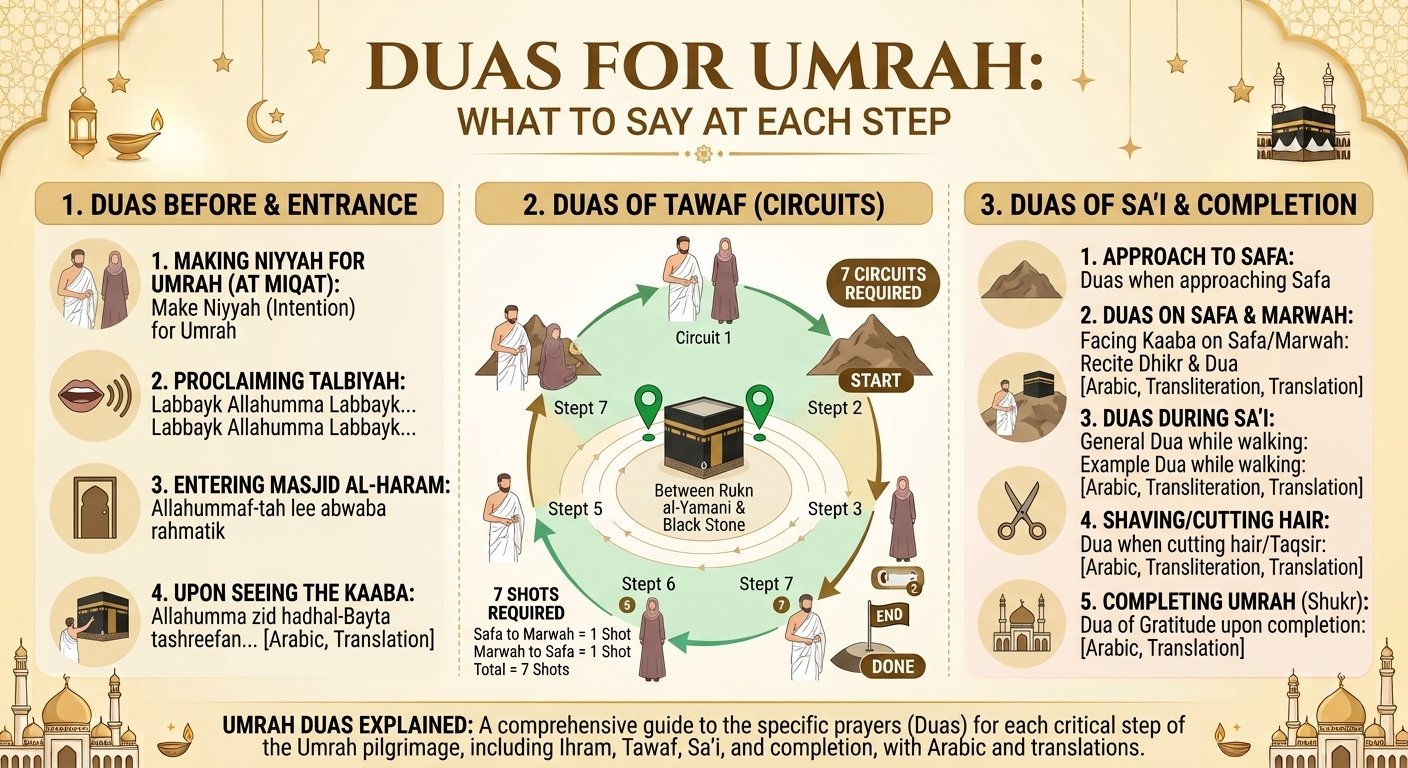
Begin the Talbiyah, the call of the pilgrim: “Labbayk Allahumma labbayk, labbayka la sharika laka labbayk, innal-hamda wan-ni’mata laka wal-mulk, la sharika lak,” meaning “Here I am, O Allah, here I am. You have no partner, here I am. All praise, grace and dominion belong to You. You have no partner.” Men recite it aloud, women softly. Repeat it often until you begin Tawaf. For the full set of supplications for every stage, see duas for Umrah.
Ihram restrictions: what you must avoid
Once in Ihram, the following are prohibited until you leave the state:
- Cutting or removing hair, and clipping nails.
- Using perfume or scented products.
- Sexual relations or intimacy, and marriage contracts.
- Hunting or killing game.
- For men: wearing stitched or fitted clothing, and covering the head.
- For women (per many scholars): covering the face with a fixed veil (niqab) or wearing gloves, though the face may be covered loosely from non-mahram men.
Breaking certain restrictions, even by mistake, can require a fidyah or dumm (an expiation such as a sacrifice or fasting). Rulings vary by situation and school of thought, so if something happens, ask a qualified scholar or your group’s religious guide rather than guessing.
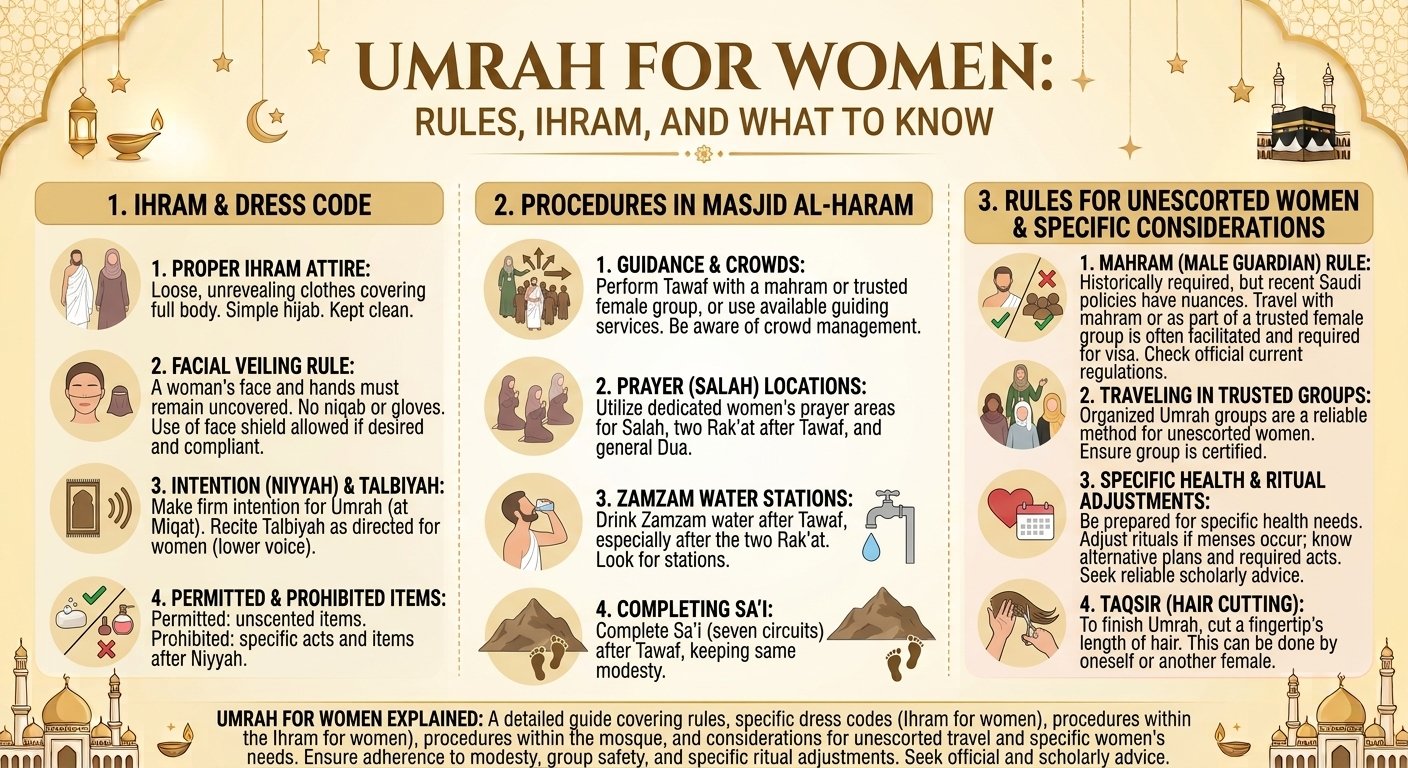
Ihram for women
Women enter Ihram the same way, intention, Talbiyah and the restrictions, but wear normal modest clothes. A woman who is menstruating may still enter Ihram and recite the Talbiyah; she simply delays Tawaf until she is pure. For a complete walkthrough, see our guide to Umrah for women.
Common Ihram mistakes to avoid
- Crossing the Miqat without entering Ihram, then having to go back or offer expiation.
- Applying perfume after entering Ihram, or to the Ihram cloth.
- Men covering the head or wearing stitched clothing out of habit.
- Forgetting to make the intention, or making it only after passing the Miqat.
- Arguing or losing patience, which weakens the spirit of Ihram.
Frequently asked questions
What are the restrictions in Ihram?
No cutting hair or nails, no perfume, no intimacy or marriage contracts, no hunting; men avoid stitched clothing and covering the head.
Where is the Miqat?
There are five Miqat points by direction, such as Dhul-Hulayfah for Madinah. Air travellers enter Ihram before crossing the point on their route.
Can women enter Ihram during menstruation?
Yes. A menstruating woman makes intention and recites the Talbiyah, and delays Tawaf until she is pure.
What happens if I break an Ihram rule?
Depending on the act, a fidyah or dumm (expiation) may be required. Rulings vary, so consult a qualified scholar.