
When people search for the types of Umrah, they are often trying to understand whether Umrah is performed on its own or together with Hajj. This can be confusing because the basic Umrah rituals remain the same, but the purpose and timing of the pilgrimage can be different.
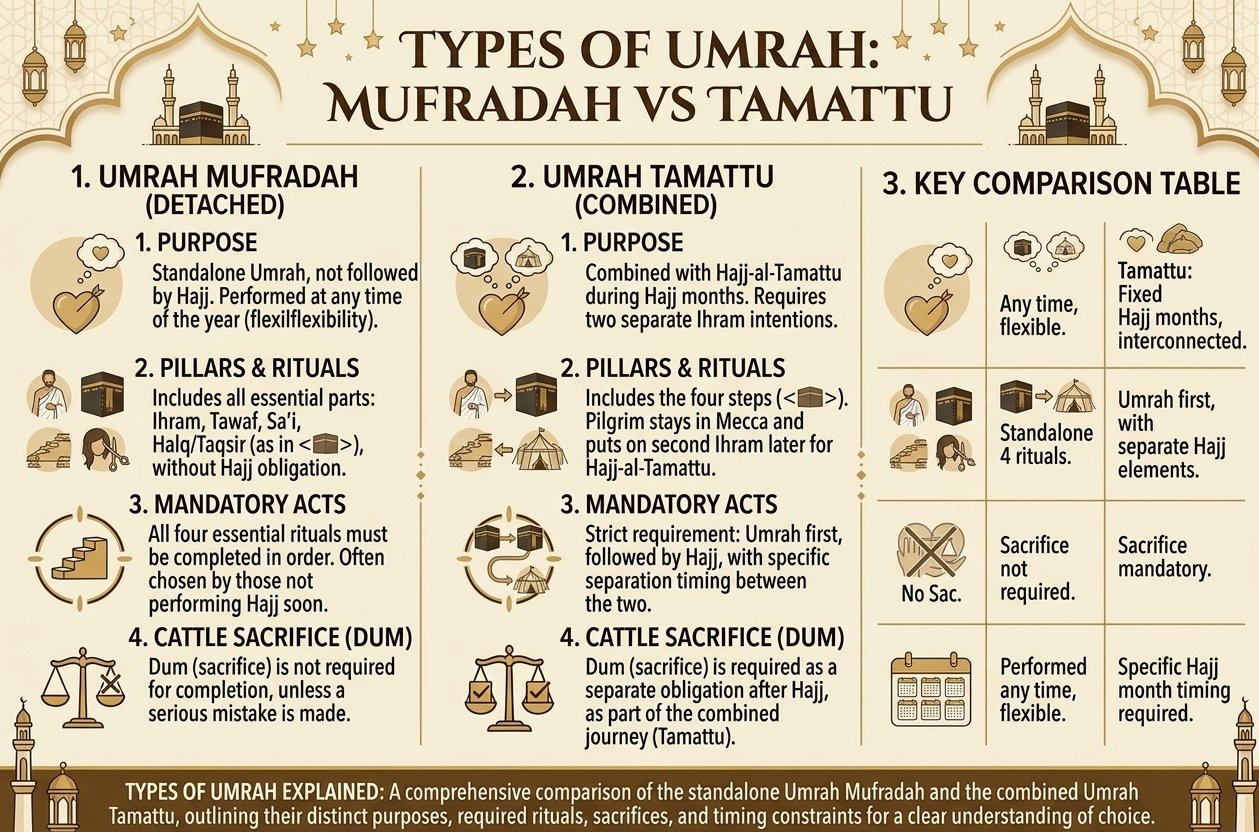
The two terms you may come across are Umrah al-Mufradah and Umrah al-Tamattu. Mufradah refers to Umrah performed independently, while Tamattu refers to Umrah performed as part of Hajj al-Tamattu.
Understanding these two terms can make it easier to know which type applies to your journey and what you should expect when planning your pilgrimage.
What Do “Types of Umrah” Really Mean?
Umrah itself has a basic set of rituals. These include entering Ihram, performing Tawaf around the Kaaba, completing Sa’i between Safa and Marwah, and then performing Halq or Taqsir, meaning shaving or cutting the hair.
These basic rituals do not become a completely different set of rituals simply because the Umrah is called Mufradah or Tamattu.
Instead, the terms describe how the Umrah is connected to Hajj.
- Umrah al-Mufradah is performed independently, without being part of Hajj.
- Umrah al-Tamattu is performed during the Hajj season as part of Hajj al-Tamattu.
For a step-by-step explanation of the rituals, see our guide on how to perform Umrah.
Umrah al-Mufradah: Standalone Umrah
Umrah al-Mufradah means an Umrah performed independently from Hajj. It is the type of Umrah many people have in mind when they plan a trip specifically for Umrah.
A person travelling to Saudi Arabia for Umrah without intending to perform Hajj as part of the same pilgrimage is generally performing a standalone Umrah.
The process includes entering Ihram with the intention for Umrah, performing Tawaf, completing Sa’i, and then cutting or shaving the hair to leave Ihram.
One of the main features of standalone Umrah is its flexibility. Umrah can generally be performed throughout the year, subject to the rules, permits and arrangements that apply at the time of travel.
This makes it possible for Muslims to plan an Umrah trip around their work, family commitments, school holidays and other responsibilities.
Many pilgrims also choose to visit Madinah during their trip. Visiting Madinah is not one of the required rituals of Umrah, but it is a common part of many pilgrimage journeys.
Who Performs Umrah al-Mufradah?
Umrah al-Mufradah may apply to a person who is travelling specifically to perform Umrah without performing Hajj during the same pilgrimage.
For example, if you book an Umrah trip outside the Hajj period and your main purpose is to perform Umrah, you are generally travelling for a standalone Umrah.
You can learn more about planning your journey through our Umrah packages.
Umrah al-Tamattu: Umrah With Hajj
Umrah al-Tamattu is different because it is connected to one of the three recognized forms of Hajj, known as Hajj al-Tamattu.
In Hajj al-Tamattu, the pilgrim performs Umrah during the Hajj season before performing the Hajj rites. After completing the Umrah, the pilgrim exits Ihram. Later, when it is time to begin Hajj, the pilgrim enters Ihram again with the intention for Hajj.
This means the pilgrim performs Umrah first and Hajj afterward during the same Hajj season.
The word “Tamattu” is associated with the period between completing Umrah and entering Ihram again for Hajj. The important point for a traveller is that this is not simply a normal standalone Umrah. It is part of a particular method of performing Hajj.
Because Hajj has additional rules and requirements, someone planning Hajj al-Tamattu should learn the complete procedure from a reliable scholarly source or qualified guide before travelling.
What Are the Main Differences Between Mufradah and Tamattu?
The easiest way to understand the difference between Umrah Mufradah and Tamattu is to look at their purpose and connection to Hajj.
1. Connection to Hajj
The biggest difference is the connection to Hajj.
Mufradah is performed independently. The pilgrim completes Umrah and does not continue into Hajj as part of the same pilgrimage.
Tamattu is connected directly to Hajj. The pilgrim first performs Umrah and then performs Hajj during the same Hajj season.
2. Timing
Standalone Umrah is generally more flexible and can be performed throughout much of the year, subject to current regulations and Hajj-season arrangements.
Tamattu is specifically connected with the Hajj season, because the Umrah is followed by Hajj.
3. Purpose
The purpose of Mufradah is to perform Umrah as an independent pilgrimage.
With Tamattu, Umrah is the first part of a particular method of performing Hajj.
4. Ihram
For Mufradah, the pilgrim enters Ihram for Umrah, completes the Umrah rituals and then exits Ihram.
For Tamattu, the pilgrim enters Ihram for Umrah first. After completing Umrah, the pilgrim exits Ihram and later enters Ihram again for Hajj.
5. Who Performs It?
Mufradah can apply to people travelling specifically for Umrah.
Tamattu applies to pilgrims who are performing Hajj al-Tamattu and therefore intend to perform both Umrah and Hajj during the same Hajj season.
Mufradah vs Tamattu: Simple Comparison
| Difference | Umrah al-Mufradah | Umrah al-Tamattu |
|---|---|---|
| Connection to Hajj | Standalone | Part of Hajj al-Tamattu |
| Timing | Generally flexible | During the Hajj season |
| Main purpose | Independent Umrah | First stage of Hajj al-Tamattu |
| Ihram | Enter Ihram for Umrah and exit after completion | Enter Ihram for Umrah, exit, then enter again for Hajj |
| Who performs it? | Pilgrims performing standalone Umrah | Pilgrims performing Hajj al-Tamattu |
This comparison is meant as a simple overview. The detailed rules of Hajj and Umrah can vary depending on the school of Islamic jurisprudence and the circumstances of the pilgrim.
Which Type of Umrah Applies to You?
The answer usually depends on what you are planning to do.
If you are travelling to Saudi Arabia specifically to perform Umrah and you are not performing Hajj as part of the same pilgrimage, you are generally performing Umrah al-Mufradah.
If you are travelling during the Hajj season and intend to perform Umrah first and then Hajj as Hajj al-Tamattu, your Umrah is part of Tamattu.
For example, a person who books an ordinary Umrah trip and returns home after completing Umrah is not performing Tamattu simply because they performed Umrah during the year. Tamattu is specifically related to the form of Hajj being performed.
If you are unsure which form applies to your circumstances, it is best to ask a qualified scholar or knowledgeable Hajj and Umrah guide before making your intention.
Are the Umrah Rituals Different in Mufradah and Tamattu?
The basic Umrah rituals remain the same.
In both cases, the pilgrim performs the main Umrah rites:
- Entering Ihram and making the intention.
- Performing Tawaf around the Kaaba.
- Performing Sa’i between Safa and Marwah.
- Completing Halq or Taqsir.
The major difference is what happens after the Umrah.
With Mufradah, the pilgrim completes Umrah and the standalone pilgrimage is finished.
With Tamattu, the pilgrim completes Umrah, exits Ihram, and later enters Ihram again to perform Hajj.
This is why understanding the connection with Hajj is more important than thinking of Mufradah and Tamattu as completely different sets of Umrah rituals.
Why Is It Important to Know the Difference?
Knowing the difference between these kinds of Umrah can help you prepare correctly.
If you are travelling only for Umrah, you need to focus on the requirements and steps of your standalone pilgrimage. You can then plan your flights, accommodation, transport and other parts of your trip according to your schedule.
If you are preparing for Hajj al-Tamattu, the situation is different because you are preparing for both Umrah and Hajj. You need to understand the requirements of both parts and follow the correct sequence.
Good preparation can also help prevent confusion about Ihram, intentions and the timing of the different rites.
If you want to understand the broader difference between the two pilgrimages, read our guide on Umrah vs Hajj.
Frequently Asked Questions
What is Umrah Mufradah?
Umrah al-Mufradah is an Umrah performed independently from Hajj. The pilgrim enters Ihram for Umrah, performs Tawaf and Sa’i, and completes the pilgrimage by shaving or cutting the hair. It is not part of Hajj al-Tamattu.
What is Umrah Tamattu?
Umrah al-Tamattu is the Umrah performed as the first part of Hajj al-Tamattu. The pilgrim performs Umrah during the Hajj season, exits Ihram after completing Umrah, and later enters Ihram again to perform Hajj.
What is the difference between Mufradah and Tamattu?
Mufradah is a standalone Umrah that is not connected to Hajj. Tamattu is an Umrah performed during the Hajj season as part of Hajj al-Tamattu, followed by Hajj.
Can I perform Mufradah Umrah during the Hajj season?
The timing and current rules around Umrah during the Hajj season can depend on Saudi regulations, permits and the official arrangements in place. If you are planning to travel during this period, check the latest requirements before booking.
Does Tamattu mean performing Umrah and Hajj together?
Yes, in the sense that both are performed during the same Hajj season and as part of Hajj al-Tamattu. However, the pilgrim completes Umrah first and exits Ihram before entering Ihram again for Hajj.
Do the Umrah rituals change between Mufradah and Tamattu?
The basic Umrah rituals remain the same: Ihram, Tawaf, Sa’i and Halq or Taqsir. The main difference is the connection to Hajj and what the pilgrim does after completing Umrah.
Final Thoughts
The types of Umrah can seem confusing at first, but the basic idea is simple.
Umrah al-Mufradah is a standalone Umrah performed independently from Hajj. It gives pilgrims the flexibility to plan an Umrah journey separately from the Hajj season, subject to current travel and Saudi regulations.
Umrah al-Tamattu is the Umrah performed as the first part of Hajj al-Tamattu. The pilgrim completes Umrah, exits Ihram and later enters Ihram again to perform Hajj.
So, if you are travelling specifically for Umrah without Hajj, Mufradah is generally the term you will encounter. If you are performing Hajj al-Tamattu, your Umrah forms the first part of that Hajj.
Understanding this difference before travelling can make your preparation easier and help you know which rituals and rules you need to study.
Planning a standalone Umrah? Explore our Umrah packages.