
One of the common questions Muslims ask before planning a pilgrimage is: Is Umrah obligatory, or is it recommended? The answer is not exactly the same across all schools of Islamic thought.
Unlike Hajj, which is clearly established as one of the five pillars of Islam and is obligatory once in a lifetime for a Muslim who is able to perform it, the ruling on Umrah has been discussed differently by Islamic scholars.
Some scholars consider Umrah obligatory once in a person’s lifetime for those who are able to perform it. Other scholars consider it a strongly recommended Sunnah rather than an obligation.
Both positions have been held by respected scholars, so it is important to understand the difference rather than assuming that there is only one opinion.
The Short Answer: Is Umrah Obligatory?
The short answer is that scholars differ on the ruling of Umrah.
According to one well-known position, Umrah is obligatory once in a lifetime for a Muslim who has the ability to perform it and meets the relevant conditions.
According to another well-known position, Umrah is a strongly recommended Sunnah and is not obligatory in the same way as Hajj.
This difference comes from how scholars understand and interpret the relevant evidence from the Quran and Sunnah.
Therefore, if you are asking “Is Umrah fard?” or “Is Umrah wajib?”, the answer depends on the school of Islamic jurisprudence and scholarly position you follow.
Why Do Scholars Differ About the Ruling of Umrah?
The difference does not mean that scholars disagree about the importance of Umrah. Rather, they have different interpretations of the evidence related to its legal status.
Scholars have examined verses of the Quran, hadith and the practice of the Prophet ﷺ when discussing whether Umrah should be classified as an obligation or as a highly recommended act of worship.
Some scholars understand the evidence as showing that Umrah is required once in a lifetime for those who are able. Other scholars understand the same body of evidence as supporting its strong recommendation rather than an obligation.
This is a recognised difference in Islamic jurisprudence. It is therefore important to present the issue fairly and avoid saying that Muslims who follow the other view are necessarily wrong.
What Do the Major Schools of Thought Say?
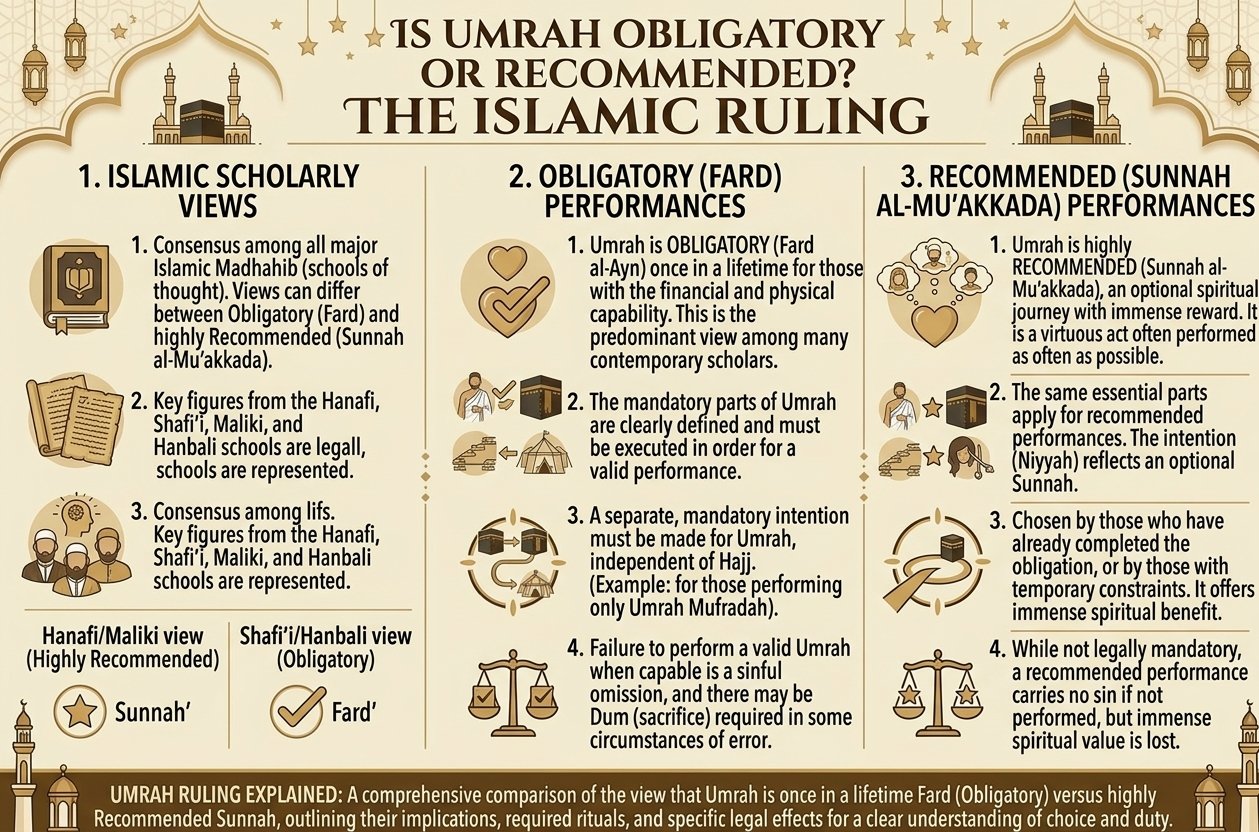
The ruling has been discussed differently among the major Sunni schools of Islamic jurisprudence.
A commonly cited summary is:
- Shafi’i school: Umrah is considered obligatory once in a lifetime for a person who has the ability.
- Hanbali school: Umrah is also generally considered obligatory once in a lifetime for those who are able.
- Hanafi school: The commonly followed position considers Umrah a strongly recommended Sunnah rather than an obligation.
- Maliki school: The commonly followed position considers Umrah recommended rather than obligatory.
There are also details and differences within the legal discussions of each school. For that reason, these points should be understood as a general overview rather than a complete explanation of each madhhab’s fiqh.
The important point is that both views are recognised within Islamic scholarship.
If you normally follow a particular madhhab, you can follow the guidance of qualified scholars within that tradition.
What Is the Difference Between Fard, Wajib and Sunnah?
Understanding a few basic terms can make this topic easier.
Fard generally refers to something that is required by Islamic law. Leaving an established fard obligation without a valid excuse is considered a serious matter.
Wajib is a term used differently in different schools of Islamic jurisprudence. In some schools, fard and wajib have a technical distinction, while in others the terms may be used more broadly.
Sunnah refers to the teachings, practices and example of the Prophet ﷺ. When scholars describe an act as a strongly recommended Sunnah, they are saying that it is highly encouraged and carries great virtue, even though they do not classify it as an obligation.
Because these terms can have slightly different technical meanings between schools, it is better not to judge a ruling based on the word alone.
Is Umrah the Same as Hajj in Terms of Obligation?
No. Hajj and Umrah are separate acts of worship, and their rulings are not identical.
Hajj is the fifth pillar of Islam. It is obligatory once in a lifetime for a Muslim who has the physical and financial ability to perform it and meets the relevant conditions.
Umrah is a separate pilgrimage. While all scholars recognise its importance and great virtue, they differ on whether it is obligatory or strongly recommended.
This is one of the important differences when comparing the two pilgrimages.
For a simple comparison of the two, read our guide on Umrah vs Hajj.
What If I Am Financially and Physically Able to Perform Umrah?
If you have the opportunity and ability to perform Umrah, it is a highly virtuous act of worship regardless of which of the recognised scholarly positions you follow.
Someone who follows the view that Umrah is obligatory would understand the pilgrimage as a duty that should be fulfilled when its conditions are met.
Someone following the view that Umrah is a strongly recommended Sunnah would still see it as an important and rewarding act of worship, but would not classify it as an obligation in the same way.
In either case, a person should consider their circumstances before making travel arrangements. This includes their finances, health, family responsibilities and ability to travel.
If you have a specific question about whether Umrah is required in your personal situation, it is better to ask a qualified scholar who understands your circumstances.
What If I Cannot Afford Umrah?
The question of ability is important in discussions about pilgrimage.
A person should not put themselves or their family into serious financial difficulty simply because they feel pressured to travel for Umrah.
The details of what counts as financial ability can differ depending on the specific ruling and school of jurisprudence. Hajj also has clear conditions relating to ability, and similar considerations are discussed when scholars address Umrah.
If you are unsure whether your financial situation makes Umrah required under the view you follow, speak with a qualified scholar rather than relying only on a general online article.
Is Umrah Still Rewarding If It Is Not Obligatory?
Yes. The fact that scholars differ about whether Umrah is obligatory does not reduce its importance or virtue.
Umrah is a major act of worship and gives Muslims an opportunity to visit the Sacred Mosque, perform Tawaf and Sa’i, make dua and devote time to worship.
A well-known hadith describes the virtue of one Umrah followed by another, stating that the time between them is an expiation for what occurs between them. This hadith is among the texts commonly cited when discussing the great virtue of Umrah.
You can learn more about this topic in our guide to the virtues of Umrah.
Should I Perform Umrah If I Am Not Sure Whether It Is Obligatory?
If you have the financial and physical ability to travel and want to perform Umrah, there is clear religious virtue in doing so.
However, whether you personally are required to perform Umrah depends on the scholarly position you follow and the conditions that apply to you.
For this reason, it is useful to separate two questions:
“Is Umrah a virtuous act?”
Yes. There is broad agreement about its importance and reward.
“Is Umrah obligatory once in a lifetime?”
There is a recognised difference of scholarly opinion on this question.
This distinction helps avoid unnecessary confusion.
What Should I Follow If Scholars Have Different Opinions?
If you normally follow a particular madhhab, you can follow the established ruling of that school.
If you do not follow a specific school, you can ask a qualified and trustworthy scholar for guidance. They can consider your personal circumstances and explain the evidence and ruling in a way that applies to you.
An online article can provide a general overview, but it cannot replace individual religious guidance when you have a specific fiqh question.
The goal is not to choose an opinion simply because it is easier. Rather, Muslims should seek reliable knowledge and follow the guidance they trust.
Frequently Asked Questions
Is Umrah fard or Sunnah?
Scholars differ on this issue. The Shafi’i and Hanbali schools generally consider Umrah obligatory once in a lifetime for those who are able, while the commonly followed Hanafi and Maliki positions consider it a strongly recommended Sunnah rather than an obligation.
Is Umrah wajib?
There is a recognised difference of opinion. Some scholars classify Umrah as obligatory once in a lifetime for those who have the ability, while other scholars classify it as a strongly recommended Sunnah.
Do all scholars agree that Umrah is obligatory?
No. The obligation of Umrah is a recognised point of difference among Islamic scholars and schools of jurisprudence. There is broader agreement about the importance and virtue of Umrah than there is about its exact legal classification.
Is Hajj obligatory but Umrah optional?
Hajj is obligatory once in a lifetime for Muslims who meet the conditions of ability. Umrah has a different ruling because scholars differ on whether it is obligatory or strongly recommended.
If Umrah is not obligatory according to my school, should I still perform it?
Yes, if you are able and wish to do so, Umrah remains a highly virtuous act of worship. The fact that a school classifies it as Sunnah rather than obligatory does not mean that Umrah is unimportant.
Do I have to perform Umrah before Hajj?
No universal rule requires every Muslim to perform a standalone Umrah before Hajj. The relationship between Hajj and Umrah depends on the type of Hajj being performed and the relevant fiqh rules.
Does the ruling on Umrah apply to everyone in the same way?
The general scholarly positions apply differently depending on factors such as ability and individual circumstances. Specific questions about finances, health, travel and other conditions should be discussed with a qualified scholar.
Final Thoughts
So, is Umrah obligatory? The answer depends on the school of Islamic jurisprudence and scholarly position you follow.
Some scholars, including the commonly cited Shafi’i and Hanbali positions, consider Umrah obligatory once in a lifetime for a person who is able to perform it. The commonly followed Hanafi and Maliki positions consider it a strongly recommended Sunnah rather than an obligation.
This difference is a recognised part of Islamic jurisprudence. It does not change the fact that Umrah is a highly virtuous act of worship and an important spiritual journey for Muslims.
If you are planning Umrah, take time to learn the correct rituals, understand the requirements that apply to you and seek guidance from a trusted scholar if you have a personal fiqh question.
If you are ready to plan your journey, explore our Umrah packages.